Categories
Uncategorized

To live better and secure crucial climate action, deliver tested wellbeing solutions

It’s within reach to live well and secure crucial climate action—making both happen is a matter of delivering tested solutions to improve collective wellbeing.

Here are some of the top such wellbeing solutions according to evidence:

Choices

Develop economic choices that allow people to make ends meet and live the life they want. Deliver choices by creating affordable and enriching options to help people in a wide range of ages, abilities, wealth/incomes, and backgrounds to meet their basic needs through:

  • Housing, especially infill middle housing;
  • Transportation, especially walkability, bikeability, and rich transit;
  • Food, especially nutritious plant-rich food; and
  • Energy, especially innovations in efficiency combined with beneficial electrification.

Delivering choices is associated with “demand-side” climate solutions, representing 40–70% of potential greenhouse gas (GHG) reductions. This category also contains some of the most cost-effective measures to reduce emissions that have been studied, which means they save energy and money that can be reinvested and multiply results.

Delivering choices also boosts self-reliance and flexibility to help people have the best chance of being ready for life-changing disasters that are becoming more common, asd well as to cope with the shocks, shifts, and uncertainties of climate change more generally.

Clean air

Keep outdoor and indoor air clean and safe to breathe, especially by curbing air pollution impacting children and other sensitive and vulnerable populations. Deliver clean air through:

  • Transition of mobile and fixed sources of energy systems to being renewably-powered and electrified;
  • Reduction of system-wide energy use through demand management and compact-oriented land use strategies; and
  • Development of strong industrial controls.

Delivering clean air is a powerful way to reduce GHG emissions, since more than 75% of these emissions come from fossil fuels that cause regional, local, and indoor air pollution. Air pollution and GHG emissions also come from livestock, fertilizers, land clearing, and industrial processes.

Delivering clean air is also important for adapting to climate change because air pollution is more dangerous during heatwaves, wildfire smoke can be transported over long distances, and air pollution is particularly harmful for people who are already vulnerable.

Community cohesion

Develop community infrastructure and services to support strong social connections, where children, seniors and people with disabilities can travel independently, people with different racial, economic, and other backgrounds are integrated, and communities can efficiently and effectively solve collective problems together. Deliver community cohesion through:1

  • Creation of compact, mixed-use design with urban forestry and urban villages where commonly used services are accessible without driving;
  • Great conditions for walking and bicycling, as part of which, vehicle speeds are overall slow (e.g., under 20 mph on local streets and less than 30 mph on urban arterials), parking capacity and subsidies are minimal;
  • Streets, parks, other public facilities, and local public schools are widely attractive; and
  • Shared resources to efficiently and effectively manage environmental challenges, including natural infrastructure and cooling centers and knowledge-sharing about changes under way and resources to help people and neighborhoods adapt.

Delivering community cohesion enables large-scale GHG reduction because it comes through designing communities to be transformationally more resource-efficient, in part by reducing the extraordinarily energy-intense process of urban sprawl, and it multiplies the possibilities of the solutions mentioned in the previous two sections.  Related movements include Smart Growth and New Urbanism.

Delivering community cohesion is important for adapting to climate change for similar reasons: It allows local governments to accomplish more with less, and it leads to neighbors being more responsive in crises–which, with climate change, often occur at the scale of communities. It also makes local governments more flexible, able to create more shared infrastructure for shared problems, and more likely to provide safety nets when needed and preventatively address root causes

Responsive government 

Dedicate government, especially local government, to provide outcome-driven wellbeing for everyone in the most efficient way, dynamically and accountably. Deliver responsive government through the following:

  • Realizing full, representative participation in voting, civic life, and other influential decision-making processes, especially for marginalized groups;
  • Managing for all ages, abilities, and backgrounds, for today and tomorrow; 
  • Commitments to using resources productive by dedicating to using best, modern practices, knowing what those are, creating space for organized innovation, and delivering services effectively; and
  • Establishing the capacity to change, or the resources, knowledge, and willingness to conduct change management—and use it.

Delivering responsive government is foundational to reducing GHG emissions because most of the transitions involved require structural changes led through public policy, and there exists extraordinary inertia that makes the existing ways of doing things–including the processes that have led to climate pollution in the first place–stable and difficult to change. The climate challenge also demands greater participation and coalition building that in turn requires a strong hand and effective participatory processes that governments are best suited to provide. And the work to be done requires acting out of comfort zones, including in terms of pace, so responsiveness is needed to create accountability to deliver on outcomes in practice.

Delivering responsive government is needed for adaptation for similar reasons, and furthermore to stay on guard as the planet changes and to respond accordingly, to change practices and strategies, to inform and educate the public about those changes and responses, to monitor and address maladaptations, and to assert collective approaches when needed.

References

1 https://www.vtpi.org/cohesion.pdf

See also the Moreworks bibliography
Categories
Uncategorized

It’s reasonable to expect to live well

With the high level of technology and financial resources of the United States, we can and should expect our citizens–all of us–to have what we need to thrive.

That means people of all ages, abilities, wealth/incomes, and backgrounds should have the conditions to achieve liberty, security, and good health.

Liberty   

Everyone should have the ability to live as they want and pursue fulfillment. That includes: 

  1. Right to shape government and full and equal access to public services;
  2. Ability to choose one’s way of life, follow one’s dreams, and have individual control of decision making;
  3. Freedom to move where and as one wants;
  4. Freedom from violence and other unjust harm (a.k.a. “security of person”); and
  5. Access to buildings, products/services, and environments that are universally accessible (a.k.a. “universal design”).

Security 

Everyone should be able to build financial and other resources and expect their future is reasonably safe from shocks that threaten their way of life. That includes: 

  1. Ability to build durable wealth and a rewarding career; 
  2. Ability to prepare for disasters and dangers while keeping valuables safe;
  3. Ability to build and maintain close family and community networks, including physically-near intergenerational living arrangements; and
  4. Reasonable assistance and protections against significant stressors and setbacks, including around the events of having children, aging, and dealing with unexpected challenges such as costly health problems, loss of a job, and loss of one’s home.  

Good health

Everyone should be able to live a physiologically-full life free of unnecessary dangers and stressors, fully benefiting from the advances in modern public health and medicine. That includes: 

  1. Ability to access safe shelter allowing adequate sleep and rest;
  2. Ability to have healthy natural movement in their daily life; 
  3. Freedom from exposure to unnecessary dangers resulting from public planning and policy, including toxic pollutants and violence from structural design;
  4. Ability to have affordable good nutrition; 
  5. Ability to physically access settings to experience connections with other people, build relationships, and achieve belonging; and
  6. Ability to access affordable high-quality preventive and treatment services to maintain and improve physical, behavioral, and emotional health, including for those in crisis.

In sum, we can and should hold policymaking and other development accountable to providing the conditions for liberty, security, and good health.

References

1 https://www.un.org/en/about-us/universal-declaration-of-human-rights

See also the Moreworks bibliography

Categories
Uncategorized

E-bikes give bicycles superpowers

Electric bicycles (e-bikes) multiply humans’ ability to pedal and balance. If you’ve used one, you have experienced bionic power. In case you’ve haven’t, read on for an explainer.

In short, a powerful small electric motor delivers three basic enhancements. Then, at the hands (and feet) of a person, those enhancements make the bicycle—already one of the most efficient machines in the universe— easier to manage and more powerful.

Three Enhancements 

The e-bike adds battery-electric power assistance to the drivetrain of a conventional bicycle. This delivers three kinds of enhancements to a bicycle:

First, it increases the rider’s power output. A typical human pedaling with legs typically delivers 20-200 of watts to a bicycle. The low end is working gently on flat ground and the high side is pushing uphill.

A battery-electric system stacks 250-1000 watts on top of that, depending on the model and power selection. Electric assistance means more power going to the bike for a given amount of effort from the human.

Second, it delivers explosive starting power. In addition to general power assistance, electric motors can immediately put a bicycle into motion in nearly any condition (e.g., under load or on a hill) with little or no effort to the pedaler.

This capability is inherent to electric motors and popularly called “instant torque” with electric cars. On a bicycle, it provides explosive launching power that can completely absorb the difficulty and fatigue involved with starts, which can be the most physically-demanding aspect of using a bicycle for transportation.

Third, it creates the option of throttle-only power. Some e-bikes, specifically, Class 2 e-bikes, carry a handlegrip throttle that delivers exclusive power assistance–in other words, power from the motor alone without pedaling.

This feature is similar to the throttle on a motorcycle, but with a low top speed. For most e-bikes with throttle-only power, assistance will cease when the bike reaches 20 MPH. 

Superhuman Abilities

So now that we have a performance-enhanced bicycle, how does the extra oomph translate to the work of actually riding?

The answer is that in nearly every aspect requiring physical effort, the bike now gives its rider superpowers. 

The new abilities include:

Distance: On an e-bike, a rider can cover 2-3 times the distance using the same amount of physical effort. Mileage may vary depending on the terrain, rider, and other factors. But in general, whatever distance or radius the operator of a conventional bike considers a comfortable travel range, it is now significantly larger.

Hills: A rider can choose to erase the challenge of most hills, from making the climb of a slope previously thought unmanageable into something comfortable to eliminating the effort needed for one or more hills on a route altogether. While the rider is subject to the constraints of the maximum output of a particular motor and the level of battery charge, in practice they are unlimited by grades designed for motor vehicles and 80% of the trips drivers take in cars.

Load: A rider can carry a surprisingly large amount of cargo weight on board (e.g., a standard longtail cargo bike might support 400 lbs), towed in a trailer (additional 100 pounds or so), or both with essentially zero extra physical exertion. Such cargo can be nearly anything, from a keg of beer to a Christmas tree to multiple children or even adult passengers. By the same principle, the rider can eliminate the force of headwind.

Ease: Just as power assistance can allow a rider to “do more” with the bicycle, it can also let them do less. Meaning, a bicycle operator can cover the same distance or terrain they did previously on a pedal-only bike, but with less strain. Or more to the point, without sweating. For some riders, this can make riding a bicycle for transportation finally feel compatible with dressing up for work or commuting in hot summer months.

Swiftness: One of the subtly extraordinary benefits of “Instant torque” is the ability to comfortably maneuver environments that require athletic starts, such as a series of uphill stoplights, with almost no physical exertion. In areas with heavy vehicle traffic and frequent intersections, this power can make the bicycle, already almost impervious to congestion, significantly faster and more enjoyable than traveling by car.

Speed: Electric assistance can bring the top speed of a bike to double or more what an average person can comfortably travel pedaling on their own (i.e., 20 vs 10 MPH). This can translate to the ability–and confidence–to traverse high-stress corridors like narrow bridges where the rider has to mix with cars, or unprotected bike lanes on fast-moving roads, in which the rider feels it necessary to get in and out as quickly as possible.

Balance: With electric bicycles that have throttle assistance, (in other words, Class 2 e-bikes), a rider has new capabilities to safely navigate hazardous conditions such as icy spots by being able to take their feet off the pedals and hold them out for balance while continuing to propel the bike forward.

Together, these abilities transform the conventional pedal-only bicycle into something categorically easier to manage and more powerful. 

Categories
Uncategorized

Research summary: IPCC’s sixth synthesis report says climate action requires transforming transportation

On March 20, 2023, the Intergovernmental Panel on Climate Change (IPCC) provided a major update on the state of climate science and ways forward in its synthesis of the Sixth Assessment Report (AR6).

Here’s what the world’s top authority on climate says about climate action and transportation:

#1. Climate change is an unfolding catastrophe.1 It multiplies the most problematic existing societal challenges and it exacerbates inequalities. Pretty much no one is left unscathed.

#2. We can head off continued warming and prepare for the unavoidable by making major coordinated commitments–which is manageable.2

#3. In fact, climate action is an opportunity to create abundance.3 The solutions called for are largely centered in creating more inclusive, affordable, healthy, and joyous communities that make people better off. Sustainable and equitable development worth doing even without the benefits of decarbonization. 

#4. Rising to the challenge means rapid, broad, and deep decarbonization of our energy supply plus five principal “demand-side” areas: Food, buildings, industry, electrification, and land transportation.4 Emissions in all areas need to rapidly peak, decline, and move to nearly zero by 2050-2070.

#5. Decarbonizing transportation requires several transformations:

  • Energy-Efficient Mobility Systems:5 Improving per-passenger energy productivity through development of systems to prioritize the widespread use of transit and other shared vehicles, vehicles right-sized for their purpose, and active transportation (e.g. bicycling and walking), meanwhile decreasing the distance between where people and things need to travel. Methods include safe streets for people outside of vehicles, more advanced public and community-based shared transportation, redesign of transportation for accessibility rather than car flow, inclusive housing, and inclusive use of public spaces. 
  • Resource-Efficient Electrification:6 Electrifying nearly every vehicle with wheels and a motor, while stewarding resources to create the most decarbonization for the materials employed. Methods include switching internal combustion engines with electric powertrains of existing vehicles in every class (e.g. cars, buses, and trucks), using the superior technology of battery-electric systems to advance new classes of highly-efficient small vehicles in urban areas (e.g. scooters and neighborhood electric vehicles), and creating new capabilities for active transportation (e.g. e-bikes). 
  • Compact Land Use: Dense infill mixed-use middle housing that lets people live near where they need to go). This strategy reduces fuel use, enables shifts to s’more energy-efficient modes, and enables day-to-day living is overall more resource-efficient and has a lighter climate impact.
  • Rigorous Demand Management:7 Creating economic incentives to reward climate-compatible travel and contain the impact of vehicles and behaviors that are in conflict with decarbonization. Methods include programs of incentives for users making everyday travel choices and capital purchases (e.g. expanded use of transportation demand management or “TDM” initiatives), structural reforms (e.g. reorganizing subsidies to move beyond car-centric planning to interoperable multimodal systems, as well as ensuring public agencies have sufficient capacity and resources to conduct such work), and new creativity in public engagement (e.g., entrepreneurship to enhance user experiences, communication, and education).

#6. Everyone has a job to do.8 Climate action around transportation requires comprehensive support for activities as varied as public policy design, advocacy, organizing, technology deployment, education, applied research, and more. Those who have influence over urban areas and financial investments taking place are especially important. Leadership is contagious.

#7. Everything we can still do matters.9 Each increment of warming avoided can make an enormous difference.


1  From the IPCC’s published Headline Statements (Headlines), Summary for Policymakers (SPM), and Longer Report (LR). As of March 22, the full volume has not yet been published. Additional detail is available in the three reports the synthesis is based on, especially the 2022 report on Mitigation.

2  Climate change is a threat to human well-being and planetary health. (Headlines C.1). Climate change has reduced food security and affected water security, hindering efforts to meet Sustainable Development Goals (SPM A.2.4). Continued emissions will further affect all major climate system components, and many changes will be irreversible on centennial to millennial time scales and become larger with increasing global warming. Without urgent, effective, and equitable mitigation and adaptation actions, climate change increasingly threatens ecosystems, biodiversity, and the livelihoods, health and wellbeing of current and future generations. (C.1.3)

3 There is a rapidly closing window of opportunity to secure a liveable and sustainable future for all. (Headlines C.1) All global modelled pathways that limit warming to 1.5°C (>50%) with no or limited overshoot, and those that limit warming to 2°C (>67%), involve rapid and deep and, in most cases, immediate greenhouse gas emissions reductions in all sectors this decade. (SPM B.6). Low-cost decarbonization opportunities abound. (SPM Figure SPM.7.a)

4  Negative decarbonization opportunities abound. (SPM Figure SPM.7.a). Deep, rapid and sustained mitigation and accelerated implementation of adaptation actions in this decade would reduce projected losses and damages for humans and ecosystems (very high confidence), and deliver many co-benefits, especially for air quality and health (C.2) Mitigation options often have synergies with other aspects of sustainable development, but some options can also have trade-offs. There are potential synergies between sustainable development and, for instance, energy efficiency and renewable energy. Similarly, depending on the context, biological CDR methods like reforestation, improved forest management, soil carbon sequestration, peatland restoration and coastal blue carbon management can enhance biodiversity and ecosystem functions, employment and local livelihoods. However, afforestation or production of biomass crops can have adverse socio-economic and environmental impacts, including on biodiversity, food and water security, local livelihoods and the rights of Indigenous Peoples, especially if implemented at large scales and where land tenure is insecure. Modeled pathways that assume using resources more efficiently or that shift global development towards sustainability include fewer challenges, such as less dependence on CDR and pressure on land and biodiversity (B.6.4)

5  Rapid and far-reaching transitions across all sectors and systems are necessary to achieve deep and sustained emissions reductions and secure a liveable and sustainable future for all. (Headlines C.3) All global modeled pathways that limit warming to 1.5°C (>50%) with no or limited overshoot, and those that limit warming to 2°C (>67%), involve rapid and deep and, in most cases, immediate greenhouse gas emissions reductions in all sectors this decade. Global net zero CO2 emissions are reached for these pathway categories, in the early 2050s and around the early 2070s, respectively. (Headlines B.6)

6 SPM Figure SPM.7.a

7 Urban systems are critical for achieving deep emissions reductions and advancing climate resilient development. Key adaptation and mitigation elements in cities include considering climate change impacts and risks (e.g. through climate services) in the design and planning of settlements and infrastructure; land use planning to achieve compact urban form, co-location of jobs and housing; supporting public transport and active mobility. (SPM C.3.4) Public transportation with bikes and rightsizing motor vehicles are among top 20 key modeled areas of mitigation, and the 5th (nearly tied with 4th) and 3rd-highest sources of mitigation that are cost-negative. (SPM Figure SPM.7.b) Urban systems are critical for achieving deep emissions reductions and advancing climate resilient development, particularly when this involves integrated planning that incorporates physical, natural and social infrastructure (high confidence). Deep emissions reductions and integrated adaptation actions are advanced by: integrated, inclusive land use planning and decision-making; compact urban form by co-locating jobs and housing; reducing or changing urban energy and material consumption; electrification in combination with low emissions sources; improved water and waste management infrastructure; and enhancing carbon uptake and storage in the urban environment (LR 4.5.3)

8 Electric vehicles powered by low-GHG emissions electricity have large potential to reduce land-based transport…The environmental footprint of battery production and growing concerns about critical minerals can be addressed by material and supply diversification strategies, energy and material efficiency improvements, and circular material flows. (SPM C.3.3)

9 Reducing industry GHG emissions entails coordinated action throughout value chains to promote all mitigation options, including demand management, energy and materials efficiency, circular material flows, as well as abatement technologies and transformational changes in production processes. (SPM C.3.3) The systemic change required to achieve rapid and deep emissions reductions and transformative adaptation to climate change is unprecedented in terms of scale, but not necessarily in terms of speed. Systems transitions include: deployment of low- or zero-emission technologies; reducing and changing demand through infrastructure design and access, socio-cultural and behavioral changes, and increased technological efficiency and adoption; social protection, climate services or other services; and protecting and restoring ecosystems. Feasible, effective, and low-cost options for mitigation and adaptation are already available. (SPM C.3.1) Electrification load brings significant new impacts that need to be reduced (SPM Figure SPM.7.b) Transport-related GHG emissions can be reduced by demand-side options and low-GHG emissions technologies. Changes in urban form, reallocation of street space for cycling and walking, digitalisation (e.g., teleworking) and programs that encourage changes in consumer behavior (e.g. transport, pricing) can reduce demand for transport services and support the shift to more energy efficient transport modes. (LR 4.5.3) Approaches that align goals and actions across sectors provide opportunities for multiple and large-scale benefits and avoided damages in the near-term. Such measures can also achieve greater benefits through cascading effects across sectors (medium confidence). For example, the feasibility of using land for both agriculture and centralized solar production can increase when such options are combined (high confidence). Similarly, integrated transport and energy infrastructure planning and operations can together reduce the environmental, social, and economic impacts of decarbonizing the transport and energy sectors (high confidence). (4.9) 

10 Urban systems are critical for achieving deep emissions reductions and advancing climate resilient development.  SPM (C.3.4) Finance, technology and international cooperation are critical enablers for accelerated climate action. (SPM C.7) 

11  There are gaps between projected emissions from implemented policies and those from NDCs and finance flows fall short of the levels needed to meet climate goals across all sectors and regions. (Headlines A.4). Every increment of global warming will intensify multiple and concurrent hazards. (Headlines B.1)

12  Climate change is a threat to human well-being and planetary health. There is a rapidly closing window of opportunity to secure a liveable and sustainable future for all. Climate resilient development integrates adaptation and mitigation to advance sustainable development for all, and is enabled by increased international cooperation including improved access to adequate financial resources, particularly for vulnerable regions, sectors and groups, and inclusive governance and coordinated policies. The choices and actions implemented in this decade will have impacts now and for thousands of years (SMP C.1). Delayed mitigation and adaptation action would lock-in high-emissions infrastructure, raise risks of stranded assets and cost-escalation, reduce feasibility, and increase losses and damages (high confidence). Near-term actions involve high up-front investments and potentially disruptive changes that can be lessened by a range of enabling policies. (C.2)

Categories
Uncategorized

Primer on transitions for climate resilience

Climate-resilient development means changing how our systems work so people can thrive as the climate changes. The Intergovernmental Panel on Climate Change (IPCC) calls these changes transitions. 

A transition is a coordinated shift in technology and infrastructure, in rules and institutions, in finance and markets, in skills and social norms, in ecosystem stewardship, and in how we use knowledge to decide and act. These shifts point in one direction. Lower emissions and lower risk. They are learning processes. They center equity and justice. They reflect local context to avoid fixes that raise risk elsewhere or later.

After a transition, emissions are structurally lower. Energy, mobility, water, food, and health services hold up better during heat, floods, fire, and storms. Systems have more redundancy and diversity so one failure does not cascade. Nature is healthier and acts as a buffer. Access is fairer and the most exposed people are safer.

How fast this can happen varies. Policy and finance can pivot within one to five years and must stay the course. End use technologies and fleets turn over in five to twenty years. Energy supply and grids often take ten to thirty years to rebuild. Urban form and major infrastructure can take twenty to fifty years or more. Ecosystem recovery and coastal reconfiguration often take decades. Acting this decade keeps options open and avoids lock in.

Energy

The energy transition cuts waste, electrifies end uses, and scales clean supply. Efficiency lowers demand in buildings, industry, and devices. Electrification moves heating, cooking, and many industrial processes to clean power. Renewables, storage, flexible demand, and modern grids become the backbone. Unabated fossil fuels decline. Grids become more resilient and smarter, with a mix of large interconnections and distributed resources like rooftop solar, batteries, and microgrids. Siting and design account for heat, wildfire, and flood. The transition supports workers and regions that depend on fossil fuels and expands affordable clean energy access.

Transportation

Mobility changes through avoid, shift, and improve. We reduce unnecessary travel with better land use and digital access. We shift more trips to public transport and active modes that are safe and convenient. We improve vehicles and fuels. Electric vehicles grow quickly as grids decarbonize. Freight uses more rail where feasible. Aviation and shipping focus on efficiency and sustainable fuels where electrification is harder. Transport networks withstand heat, flood, and storms through better materials, elevation, rerouting, and redundancy.

Urbanism 

Cities grow in ways that cut emissions and reduce risk. Compact, connected, mixed use neighborhoods shorten trips and support transit and walking. Buildings are efficient, well insulated, and designed for heat and smoke. Blue green infrastructure adds trees, parks, wetlands, and permeable surfaces that cool and absorb water. Land use, transport, water, and waste planning are integrated. Circular systems reduce waste and reuse water and materials. Emergency services have reliable access during extremes. Critical services can be decentralized when that improves reliability. Equity sits at the center through inclusive planning, slum upgrading, tenure security, and universal basic services for water, sanitation, cooling, and mobility.

Agriculture, water, and ecosystems

Food systems face rising heat, drought, flood, pests, and price shocks. The transition puts food and farm resilience up front. Farmers diversify crops and livestock, use agroecology, improve soils, harvest and store water, and use climate services for decisions. Cold chains, storage, and logistics reduce losses. Diets move toward healthy, sustainable options and food waste falls, which eases pressure on land and water. Water is managed across whole basins with demand management, nature based storage, reuse, and risk reduction for droughts and floods. Forests, wetlands, grasslands, rivers, and reefs are protected and restored, and landscapes stay connected so species can move. Coasts plan for rising seas with setbacks, buffers, and ecosystem based protection such as mangroves and reefs. Where risk becomes too high, managed retreat lowers harm. Indigenous rights and knowledge are respected and benefits and risks are shared fairly.

Health, livelihoods, and social protection

People face heat, disease, smoke, and displacement. Health systems prepare with heat action plans, climate informed primary care, and early warning that reaches every household. Safety from wildfire and other disasters is explicit in plans. Communities have clean air shelters, HEPA filtration, and N95 distribution for smoke. Hospitals, clinics, and schools have backup power and cooling. Evacuation routes, alerts, and shelters are accessible for people with disabilities, older adults, and families with young children. Programs harden homes against fire and storms and support retrofits for cooling and air quality. Universal access to water, sanitation, and hygiene reduces disease risk. Social protection cushions shocks through cash transfers, public works, insurance, and programs that scale automatically during disasters. Livelihoods diversify and education builds skills for new jobs. Mental health support is available after disasters.

Finance and governance

Money, rules, and skills enable everything above. Public and private finance scale up and shift toward mitigation and adaptation. Adaptation finance gaps close, especially in low income and climate vulnerable regions. Disclosure and pricing of climate risk become standard. Risk pooling and instruments for loss and damage expand. Governance is inclusive and multi level so communities, cities, regions, and nations work in concert. Decisions use scenarios and stress tests to manage uncertainty. Knowledge is co-produced with local and Indigenous communities. Education and workforce programs spread the skills needed for a just transition.

What success looks like 

If we are on track, emissions will fall. Losses from climate hazards stop rising as quickly even as hazards grow. Access to energy, mobility, cooling, water, food, and health improves. Exposure of high risk groups declines. Ecosystems recover and provide stronger services like cooling, flood control, and carbon storage. Investment patterns, institutions, and daily choices reinforce these gains rather than undermine them.

References

IPCC (2022). Climate Change 2022 Summary for Policymakers. Working Group II Sixth Assessment Report. https://www.ipcc.ch/report/ar6/wg2/

IPCC (2023). AR6 Synthesis Report. Intergovernmental Panel on Climate Change. https://www.ipcc.ch/report/ar6/syr/

Schaeffer R et al. (2025). Ten new insights in climate science 2024. One Earth. https://www.sciencedirect.com/science/article/pii/S2590332225001113

FAO (2021). The State of Food and Agriculture 2021. Making agrifood systems more resilient to shocks and stresses. Food and Agriculture Organization of the United Nations. https://www.fao.org/publications/sofa/2021/en/

Lancet Countdown (2024). 2024 report of the Lancet Countdown on health and climate change. The Lancet. https://www.lancetcountdown.org/2024-report/

Categories
Uncategorized

To secure crucial climate action, focus on resilience

What is climate action?

According to the Intergovernmental Panel on Climate Change (IPCC), which is the most widely-accepted international scientific body on climate change, when we think about climate action, we should think climate-resilient development.1

Climate-resilient development means deeply reducing greenhouse gas emissions (“mitigation”) while dealing with the changing climate already coming at us (“adaptation”) and doing both in a way that supports sustainable development for everyone.

Mitigation

Mitigationmeans reducing greenhouse gas emissions.2 The magnitude of reduction needed is associated with limiting global warming by as close as possible to 1.5C (2.7F) degrees. Overall that means reducing half of global emissions from the period of 2023 (IPCC’s most recent major update) by 2030.

The US’ likely best ways to support that transition, as evaluated in 2024 by the Biden adminstration, are to (1) decarbonize the energy sector (focusing on cutting energy waste; shifting to carbon pollution-free electricity; electrifying and driving efficiency in vehicles, buildings, and parts of industry), (2) reduce emissions from forests and agriculture and enhancing carbon sinks, and (3) reduce non-CO2 greenhouse gases including methane, hydrofluorocarbons, and other potent short-lived climate pollutants.

For the US to carry its fair share, it needs reduce its emissions by about half from 2024 to 2030, or about 6,400 metric tons of carbon dioxide equivalents (MtCO2e), according to Climate Action Tracker, which monitors and evaluates countries’ commitments.

The US’ actual commitment as of November 2024 (per its nationally-determined contribution submitted to the UN Framework Convention on Climate Change) was about 22-28% for the period of 2024 to 2030. 3

Adaptation

Adaptationmeans adapting to the changes underway. It also specifically means avoiding maladaptation, or in other words, responses that worsen existing inequities, especially for Indigenous Peoples and marginalized groups, or that hurt ecosystem and biodiversity resilience.

Adaptation is a process that can take place over the range of multiple timescales, from nearer term to longer term, and really any physical level, from the whole human civilization on down.

Sustainable development for everyone

Sustainable development for everyone means centering justice, equity, and inclusion in investments and other commitments in order to avoid perpetuating historical and ongoing injustices, inequities, exclusions, and that reconcile divergent interests, values and worldviews toward equitable and just outcomes for all.

Sustainable development for everyone specifically involves building a just transition, or managing the shift to a low-carbon economy in a way that is fair and inclusive, ensuring that no one is left behind.

Such responses work more broadly to meet, and ideally create synergies with the UN sustainable development goals (SDGs).

The three processes of mitigation, adaptation, and sustainble development for everyone together can be considered “climate-resilient development.”

The three aspects are related and affect each another. For example, initiatives that aim to support mitigation need to be adaptable to a heating climate or they could fail. Also, a community’s needs for adaptation are a function of how much warming is prevented by mitigation. And responses that are just, equitable, and inclusive are likely to strengthen the possibilities for mitigation and adaptation.

References

1 Intergovernmental Panel on Climate Change (2023). AR6 Synthesis Report: Climate Change 2023. https://www.ipcc.ch/report/sixth-assessment-report-cycle/

2 https://globalecoguy.org/we-need-to-see-the-whole-board-to-stop-climate-change-98be66412281

3 https://climateactiontracker.org/countries/usa

Click to access United%20States%20NDC%20April%2021%202021%20Final.pdf

The US commitment is to reduce emissions from 2005 levels (7.4 gt total and 6.7 gt net) by about half (50-52%) by 2030. The US is projected to achieve about half of that reduction (26-28%) by 2025.

Intergovernmental Panel on Climate Change (2022). Mitigation of Climate Change. Contribution of Working Group III to the Sixth Assessment Report of the Intergovernmental Panel. See especially Technical Summary. https://www.ipcc.ch/report/ar6/wg3/

See also the Moreworks bibliography

Categories
Science

Transportation questions for climate advocates

To bring climate pollution under control, we need to reshape transportation, especially the way we get around on the ground.

Namely, we have to evolve from a mono-modal system that is extraordinarily energy-intensive because it requires one tool for almost every job–the private car, typically carrying one person–towards a system that is resource-efficient.

No question a big part of resource efficiency is more efficient motors with cleaner energy sources. That means electrifying more or less every motor vehicle.

But just as important, and what we needs more attention, is making the system architecture into one that is multimodal. An architecture that provides a diversity of travel choices giving people multiple good options. That ferrets out subsidies working against the most economic travel tool for the job in order to give the most climate-compatible modes a level playing field. That multiplies the possibilities through “geometric efficiency”–by designing and redesigning communities to give people more amenities near where they live.

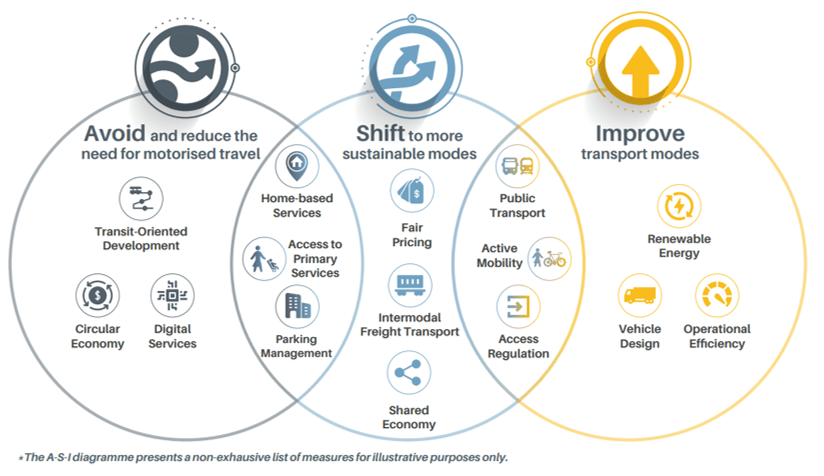
This system we need is one that is designed to first avoid the need for physical travel and next let people frictionlessly shift to the most efficient and convenient mode for the trip. See figure for a summary of these strategies, together “avoid/shift,” in context.

Avoid-Shift-Improve Framework from SLOCAT (reference at bottom)

Four questions will shape how and when we get to the multimodal, resource-efficient system that we need–and whether transportation leaders will do their part in delivering a safe climate:

  1. How do we give bicycle/pedestrian and transit development the high status climate science and literature on equity say they deserve?
  2. How can transportation electrification and “avoid/shift” climate strategies work harmoniously towards a holistic transportation decarbonization agenda?
  3. What’s it going to take to get public agencies to take serious climate action, which requires–according to the most authoritative science–a revolution in mobility options on top of electrification?
  4. How can resource-limited local governments rapidly take it the next level for combined transportation decarbonization, equity, and resilience?
  5. How do we overcome carbon lock-in that makes the transportation difficult and spark new action?

There’s a lot packed in here. How we pay for things (and quietly subsidize the status quo). The role of emerging technology. Paths to diffusion of technology and solutions that already exist but at small scale. How to be more appropriately imaginative. And more.

Watch this space for materials and perspectives to explore these issues. A goal is to better understand the untapped value mobility offers the climate movement and what we can do about it. As well as the potentially untapped popular support for initiatives that give people time, money, and freedom back once we get the flywheel really moving.

READING

IPCC (April 2022). Mitigation of Climate Change. Contribution of Working Group III to the Sixth Assessment Report of the Intergovernmental Panel.

Litman, Todd (2022). Evaluating Transportation Equity Guidance for Incorporating Distributional Impacts in Transport Planning. Victoria Transport Policy Institute.

SLOCAT: Partnership on Sustainable, Low Carbon Transport (2021). Transport and Climate Change Global Status Report — 2nd Edition.

Unruh, Greg (2002). Escaping Carbon Lock-in. Energy Policy.

Categories
Uncategorized

Primer on subnational climate action

Subnational climate action means everything that happens below the federal level. Cities, counties, regional agencies, states, multi state coalitions, and interstate institutions set rules and invest public dollars.

Subnational policy shapes markets, unlocks private capital, and builds the record that supports durable national standards. It spreads a few ways.

First, it creates working examples. A city or state proves a rule or program can work, then peers copy it and vendors standardize around it.

Second, it builds markets that lower costs. Public procurement and utility programs create steady demand that pulls in manufacturing and finance.

Third, it uses planning and permitting authority to direct dollars and projects.

Fourth, it establishes a technical and legal record that supports stronger federal standards later. The result is a set of local and regional moves that add up to national behavior long before a federal rule arrives.

Cities and counties

Cities and counties control land use, zoning, building codes, building performance standards, and permitting. Building performance standards, often shortened to BPS, set energy or emissions limits for large buildings and drive demand for heat pumps, smart controls, and retrofits. Local governments run fleets and buy buses, trucks, and construction materials. Electrification ready codes and streamlined permits reduce soft costs and speed adoption.

Local action can also advance national practice when done together. Cities can adopt common templates for electric vehicle ready requirements, clean construction, and benchmarking. They can pool purchases of buses and trucks, share compliance tools and data, and align timelines. When many cities move in concert, vendors face one clear set of expectations, which speeds product development and lowers costs across the country.

Intrastate (or “sub-state”) regional agencies

Metropolitan Planning Organizations, known as MPOs, program federal transportation dollars through long range plans and a Transportation Improvement Program, called a TIP. Plans must conform to the emissions budget in the State Implementation Plan, or SIP. Some states also set greenhouse gas targets for MPOs. When MPOs shift funds toward transit, maintenance, safe streets, managed lanes, and charging depots, vehicle miles traveled, or VMT, grows more slowly and fleets electrify faster.

Transit agencies operate bus and rail systems and manage large depots and right of way. They plan service, buy vehicles, install chargers and grid upgrades, and coordinate street design with cities and MPOs. Major procurements of zero emission buses and charging equipment create predictable demand that manufacturers serve nationwide. Service that is frequent, reliable, and safe also reduces driving, which cuts emissions and improves local air quality.

Air quality management districts write rules and permits that feed into the SIP under the federal Clean Air Act. They target nitrogen oxides, called NOx, and volatile organic compounds, called VOCs, to meet health standards. Many regulate pollution from freight hubs through indirect source rules for warehouses, ports, and airports, and through tighter limits on combustion equipment. Because logistics networks operate across state lines, strong rules in major hubs push markets for zero emission trucks, cargo handling equipment, and cleaner industrial heat across the country. These rules also generate data and legal precedent that support stronger Environmental Protection Agency standards later.

States and utility regulators

States set greenhouse gas targets and pass laws that require cleaner electricity such as a Renewable Portfolio Standard or a Clean Electricity Standard. They update building codes and BPS, adopt appliance standards, regulate methane and industrial emissions, and manage siting for energy projects. States deploy funding from the Infrastructure Investment and Jobs Act and the Inflation Reduction Act, often written as IIJA and IRA. Many run green banks and use public purchasing through Buy Clean programs that prefer lower carbon materials.

Public Utility Commissions and Public Service Commissions, often shortened to PUCs and PSCs, regulate utilities. They approve resource plans, transmission and distribution upgrades, interconnection reforms, demand side programs, and rates. Early state action proves feasibility and lowers costs. PUC decisions unlock large clean power builds and improve reliability, which reduces national prices and risk for private investors.

Multistate coalitions and agreements

Governor led coalitions such as the United States Climate Alliance and sector agreements on zero emission cars and trucks align targets, timelines, and model policies. Harmonized rules reduce compliance friction, speed replication across states, and signal a stable market to investors and manufacturers.

Interstate regional agencies

Regional Transmission Organizations and Independent System Operators, known as RTOs and ISOs, operate wholesale power markets and plan transmission under the Federal Energy Regulatory Commission, or FERC. They manage interconnection queues and resource adequacy. Stronger regional transmission, better queue management, and fair rules for storage and demand response enable gigawatt scale clean energy additions across multiple states. These changes lower costs for wide areas and make federal standards easier to implement.

Interstate carbon and fuel markets also create durable price signals. The Regional Greenhouse Gas Initiative, or RGGI, caps power sector carbon dioxide across several Northeast and Mid Atlantic states and invests allowance revenue in clean energy and efficiency. The Western Climate Initiative links California and Qu├ębec in a cap and trade system that covers multiple sectors. Low Carbon Fuel Standard programs, or LCFS, in California, Oregon, and Washington create credits for lower carbon fuels and for electricity used in transportation. Shared methods for measuring emissions and credits let firms operate at multi state scale and provide evidence that informs future federal rules.

Coalition of “Section 177” states

Under Section 177 of the Clean Air Act, states can adopt California vehicle emission standards after the Environmental Protection Agency grants California a waiver. These programs include Advanced Clean Cars II for light duty zero emission vehicle sales and Advanced Clean Trucks for medium and heavy duty sales. When many states adopt these programs without change, their combined market share creates a national trajectory for zero emission vehicles in practice. Automakers and fleet operators then plan and invest on a national basis, which supports stronger Environmental Protection Agency standards later.

Why subnational action matters

It accelerates scale and speed because local, regional, and state programs can move before federal rules arrive. It lowers costs because public procurement, utility programs, and regional power markets create steady demand that pulls down prices for vehicles, chargers, heat pumps, storage, and clean power. It protects public health because air and transportation actions reduce NOx and fine particles where burdens are highest. It builds the technical and legal record that federal agencies need to issue durable nationwide standards. It strengthens economic competitiveness because coordinated subnational demand anchors domestic supply chains and skilled jobs. It also preserves momentum if federal policy pauses because state and local action keeps progress moving.

Local codes and BPS spark demand for clean buildings and fleets. Intrastate regional agencies focus that demand at freight hubs and along major corridors and translate it into real projects and service. State laws and PUC decisions scale clean power and building electrification while deploying IIJA and IRA funds. Interstate agencies unlock transmission, fair market access, and consistent carbon and fuel signals, which lowers costs across many states. Multi state coalitions and Section 177 adoption align methods and timelines so companies face consistent expectations across very large markets. Federal agencies can then lift and lock in these proven approaches through nationwide standards.

Subnational action is the engine that turns goals into markets, turns markets into standards, and turns standards into durable national progress.

Categories
Uncategorized

Primer on local government

Local communities are served by one or more local government agency (e.g., municipality, county government, and school, transit, and water districts). 

Local governments:

  • Deliver essential day-to-day services like emergency response, transportation, water, wastewater, waste management, and the provision of shared public places like parks, recreation centers, and libraries;
  • Plan and solve common problems around public safety, land use and zoning, permitting, budgeting, and the levying of taxes and fees;
  • Coordinate with neighboring jurisdictions and other outside partners;
  • Represent residents to higher levels of government and other entities: and
  • Provide an elected government with democratic processes that is typically closest to people

Local governments have some important differences compared to their federal and state counterparts. For one, they possess specialized authority to manage land use, transportation, buildings, public health, and emergency preparation and response, all key building blocks for climate solutions and quality of life in communities.

They also operate differently. What they are able to accomplish, and what they are not, is constrained by personnel bandwidth and management practices to a higher degree than higher jurisdictions. 

By extension, mic governments can be inhibited by processes of change and disruption, which tend to require involvement from legal, public engagement, and coordination across multiple departments.

Categories
Uncategorized

High-reward climate action: Safe streets

When people think of climate solutions, the mind often goes to things that need be installed: Solar and wind, battery storage, building retrofits, tree planting, and carbon removal. All are essential.

Yet a powerful, fast-payback lever hides in plain sight: designing streets for safety. Safer streets cut emissions directly and acts as a force multiplier for transportation decarbonization—one of the largest sources of climate pollution in many countries and an area where progress must accelerate.

Safe streets unlock “avoid and shift,” the fastest path to lower transportation emissions. The biggest gains come first from avoiding car trips through better land use, then from shifting remaining trips to walking, cycling, and transit.

Avoiding and shifting multiply what is possible with vehicle improvements by reducing the number and length of car trips before technology even enters the picture.

Safety is the skeleton key that lets avoid and shift scale in transportation—and it delivers unusually strong returns on investment. Compared with large capital projects, quick-build safety upgrades, protected bike networks, safer crossings, and bus priority can be delivered rapidly, save lives immediately, reduce vehicle miles traveled, and unlock further climate benefits. This is not marginal action; it is a force multiplier that climate advocates should prioritize.

Bicycling and walking

Research shows that most people’s relationship with a bicycle for transportation is that they are “interested” but concerned that the risks and stress are too much. They’re open to bicyling and walking if it feels safe and convenient, but not if it feels exposed or confusing.

Perceived safety governs behavior. That means physical protection from fast traffic, lower speeds where people move, frequent and visible crossings, lighting, and predictable intersections. Where cities reduce vehicle speeds and add protected bike lanes and continuous sidewalks, injuries fall and the share of trips by foot and bike rises. As more people use these facilities, drivers expect them and everyone gets safer. This is how shift happens at scale.

Public transit

Safe streets enable transit in turn. Every rider is a pedestrian for part of the trip. If it is hard to cross to a stop, if the stop lacks lighting or a curb, or if the last block home has no sidewalk, the experience is unacceptable. Safer crossings, traffic calming on transit corridors, and priority for buses at signals make the whole trip safe and trustworthy, which builds ridership and reduces crashes at the same time.

Transit also creates a feedback loop: Per passenger mile, the mode is safer than driving for everyone. Vehicles are larger and driven by trained professionals, and each bus or train replaces many cars, which reduces conflicts on the street. Good transit also gives people who should not drive a better option. Teens, older adults, people with certain medical conditions, and anyone who is tired have a safe alternative when service is frequent and reliable.

Transit upgrades are also high-ROI: modest signal changes, dedicated lanes, and safer stop access can deliver large travel-time and safety gains at a fraction of the cost of roadway widening.

Efficient vehicles, electric and otherwise

Safe streets also enable smaller, lighter vehicles—and help end the arms race toward bigger and heavier ones. Lower-speed networks, traffic calming, and separated facilities make compact cars, neighborhood electric vehicles (NEVs), and microcars practical for everyday travel. In many jurisdictions, NEVs can operate on lower-speed streets; when those streets are designed for safety, households can right-size to vehicles that consume far less energy and pose less risk to others.

This reverses the trend toward ever-larger vehicles driven by high-speed, high-volume roads and crash incompatibility. Designing for safe, lower speeds makes small, efficient vehicles viable, which further reduces emissions, space needs, and crash severity.

And it matters even for electric: When considering the overall vehicle fleet, a proportion that is meaingfully smaller and lighter corresponds to a meaingfully lower GHG footprint. It also means fewer materials and resources for electrification are needed per vehicle, which has an additional effect in aggregate. Finally, a more circumspect average vehicle profile is safer for those traveling outside vehicle cabins, like walkers and cyclists, which in large numbers induces more of the lightest travel of all.

Compact, human-centered neighborhoods

Compact, mixed-use neighborhoods reduce daily travel needs so people can reach most essentials with short trips. A connected street network, homes near jobs and schools, and local services within a short walk or ride lower vehicle miles traveled across the entire community.

That cuts emissions and makes streets safer, because shorter trips on calmer streets mean fewer high-speed impacts. Children can reach a park without crossing a five-lane road. An older neighbor can get to a cafe without a long drive. People using mobility aids can count on accessible paths. Safety becomes part of daily life rather than a personal burden.

The wider built environment

Crucially, the same choices that make streets safer also produce a more resource‑efficient, resilient built environment. Designing for compact, walkable places concentrates activity where efficient, electrified buildings and infrastructure perform best.

Shorter distances and attached or smaller homes reduce heating and cooling loads, making heat pumps and building electrification more cost‑effective.

Mixed-use, human‑scaled districts support district energy and shared infrastructure, lower peak electricity demand, and improve the economics of rooftop solar, storage, and demand flexibility.

Denser, walkable street grids cut materials use per capita, reduce stormwater runoff with less paved area per person, and shorten utility extensions—saving public money while boosting resilience to heat, outages, and extreme weather.

In other words, safe streets do double duty: they accelerate transportation decarbonization and strengthen the broader clean‑energy transition across buildings and grids.

In sum, improved vehicles and fuels are necessary but not sufficient. Heavier vehicles can increase the harm in crashes and crowd out the space needed for people outside cars. When streets feel safe, households can right-size travel: walk for a half mile, use a bike or e‑bike for a few miles, take a bus or train for longer trips, and use a car when it is the best tool for the job. This pattern cuts emissions faster and reduces risk right away. It also reduces the scale of infrastructure and energy systems needed for full decarbonization, improving the return on every dollar invested in electrification and clean power.

The benefits of this pathway are wide and personal. Health improves when more people can safely walk or bike for short trips. Cleaner air reduces asthma and heart disease. Most important, fewer families experience the grief and lifelong injury that follow serious crashes.

Freedom expands as more people can travel without a car. A 12‑year‑old can bike to a friend’s house. An 82‑year‑old can cross to a pharmacy. A parent can let a child walk to school without fear. Households save money when they can own fewer and smaller vehicles.

Towns and cities save money when safer street designs reduce crashes and when compact, multimodal infrastructure costs less to build and maintain than endless lanes that must be widened again and again. For climate advocates focused on impact per dollar and speed of deployment, safe streets deliver exceptional returns now and set the stage for every other climate solution to work better.

Unlock the multipliers of avoid and shift with safety. Lower speeds where people live and shop. Build connected, protected networks for walking and cycling. Fix crossings to make them frequent and visible. Invest in frequent, reliable transit and safe access to every stop. Plan for mixed uses and connected streets. These steps cut emissions, save lives, expand freedom, strengthen the clean‑energy transition in buildings and grids, and save money. Safe streets are high‑ROI climate action—and a catalyst for more.

References

Dill, J., and McNeil, N. (2013). Four Types of Cyclists? Examination of a Typology for Better Understanding of Bicycling Behavior. Transportation Research Record. https://doi.org/10.3141/2387-01

Teschke, K., et al. (2012). Route Infrastructure and the Risk of Injuries to Bicyclists. American Journal of Public Health. https://doi.org/10.2105/AJPH.2012.300762

Litman, T. (2021). A New Transit Safety Narrative. Victoria Transport Policy Institute. https://www.vtpi.org/safer.pdf

Ewing, R., and Cervero, R. (2010). Travel and the Built Environment. Journal of the American Planning Association. https://doi.org/10.1080/01944361003766766

FHWA (2021). Safe System Approach. Federal Highway Administration. https://highways.dot.gov/safety/zero-deaths/safe-system-approach

IPCC (2022). Climate Change 2022 Mitigation of Climate Change. Working Group III contribution. https://www.ipcc.ch/report/ar6/wg3/

PNAS (2025). Global health and climate benefits from walking and cycling. Proceedings of the National Academy of Sciences. https://www.pnas.org/doi/10.1073/pnas.2422334122

UCLA Institute of Transportation Studies (2025). Active travel study identifies pathways for walking and cycling friendly cities. UCLA ITS. https://www.its.ucla.edu/2025/06/09/active-travel-study-identifies-pathways-for-walking-cycling-friendly-cities/

Categories
Uncategorized

Efficiency improvements through electric vehicles: You don’t know the half of it

Electrifying transportation seems like magic because the core machine is so much better at turning energy into motion.

A typical electric drivetrain is about three times as efficient as a gasoline one, and it runs on a fuel that can steadily move toward being 100% renewable and carbon-free.

EVs bring other benefits too, like quiet streets and low maintenance, but the headline is simple. Its superpower is efficiency. We are talking about roughly 0.27 kWh per mile for a mid-size EV, equivalent to about 125 MPG.

That gap alone is enough to deeply cut emissions as the grid cleans up. Yet there is another side to efficiency that most people miss.

The way most of us travel day to day is overbuilt for the job. One person, often alone, moving at low average speeds through city streets in a 3,000 to 5,000+ lb vehicle.

Most of the energy goes to pushing a heavy machine and a lot of air, not to moving a human body. On a typical urban trip, about 95% of the energy moves the vehicle, and only about 5% moves the person.

That is not a moral judgment. It is physics.

When you repeatedly accelerate two tons in stop-and-go traffic, you spend energy on mass. When you cruise with a large frontal area, you spend energy on drag. Either way, the human is the smallest part of the payload.

The battery-electric revolution opens the door to right-sized electric mobility that flips this ratio. Electric motors scale beautifully. They are compact, efficient, and happy at many sizes.

That is why we now have an entire family of vehicles that can deliver a full trip at a fraction of the energy. Think e-scooters, e-bikes and cargo bikes, mopeds, compact city EVs, and neighborhood electric vehicles. The savings are not subtle.

A typical e-bike uses about 10 to 20 Wh per mile. At the U.S. average residential electricity price, that is well under one cent per mile. A small neighborhood EV might use 80 to 150 Wh per mile, still many times less than a full-size car.

Compare that with a gasoline sedan at around 1,100 Wh per mile worth of fuel energy, or even a mid-size EV at about 250 to 300 Wh per mile, and the order-of-magnitude difference becomes clear.

Right-sizing brings other gains. Smaller electric vehicles need smaller batteries, which lowers cost and materials demand. They can charge from an ordinary outlet overnight. Parking gets easier. Streets get calmer. Air gets cleaner where people live.

These are resilience benefits as well. A household with a mix of light electric options can keep moving even during fuel disruptions, and a car with a modest battery can backstop outages at home with vehicle-to-load gear. Cities that shift short trips to light electric modes need less space and less money to move more people.

None of this argues against the mainstream EV. For many trips, a conventional car is the right tool, and replacing a gasoline car with an electric one cuts energy use by a factor of three or four before you account for the grid’s ongoing shift to renewables. It is simply that our efficiency story is incomplete if it stops at the car-for-car swap. The lowest-cost, lowest-carbon, and most space-efficient miles will often be ridden, not driven.

The good news is we are already living in this future. Most urban trips are short enough for light electric mobility. In the United States, roughly half of all trips are under three miles. That is e-bike territory for many people and many days, with weather gear and cargo options making it practical for more. Cities that add safe networks for small vehicles see rapid uptake, because the product is compelling. It is fun, fast enough, cheap to run, and simple to maintain.

If you want a simple mental model, use this. Electrification gives you a big step up in efficiency at any vehicle size. Downsizing gives you another. Stack them and you get both deep decarbonization and better daily life. We can triple drivetrain efficiency by moving from internal combustion to electric. We can multiply total-system efficiency again by choosing the smallest electric that does the job. The result is cleaner air, lower costs, quieter streets, and far less energy burned to move the same person from A to B.

So by all means celebrate the conventional electric car. It is a workhorse and a crucial climate tool. Then look at the rest of the electric toolbox and pick the right size for the job. The fastest way to win on energy and money is to electrify, and then right-size.

Categories
Uncategorized

Let’s create *more*

A big untapped source of potential climate action is public-oriented infrastructure and other initiatives that improve well-being and make life better.

And one of the ways public-mission professionals can achieve greater impact is to use their capabilities to drive win-win, concrete results for the climate movement.

For changemakers all around, there are incredible opportunities to focus on the things that advance crucial climate action and make life better together.

Moreworks is here to help explore, lead, and assist in that endeavor.

Watch here to see knowledge resources for changemakers to unfold.

Inquiries about working other are most welcome at the contact page.